
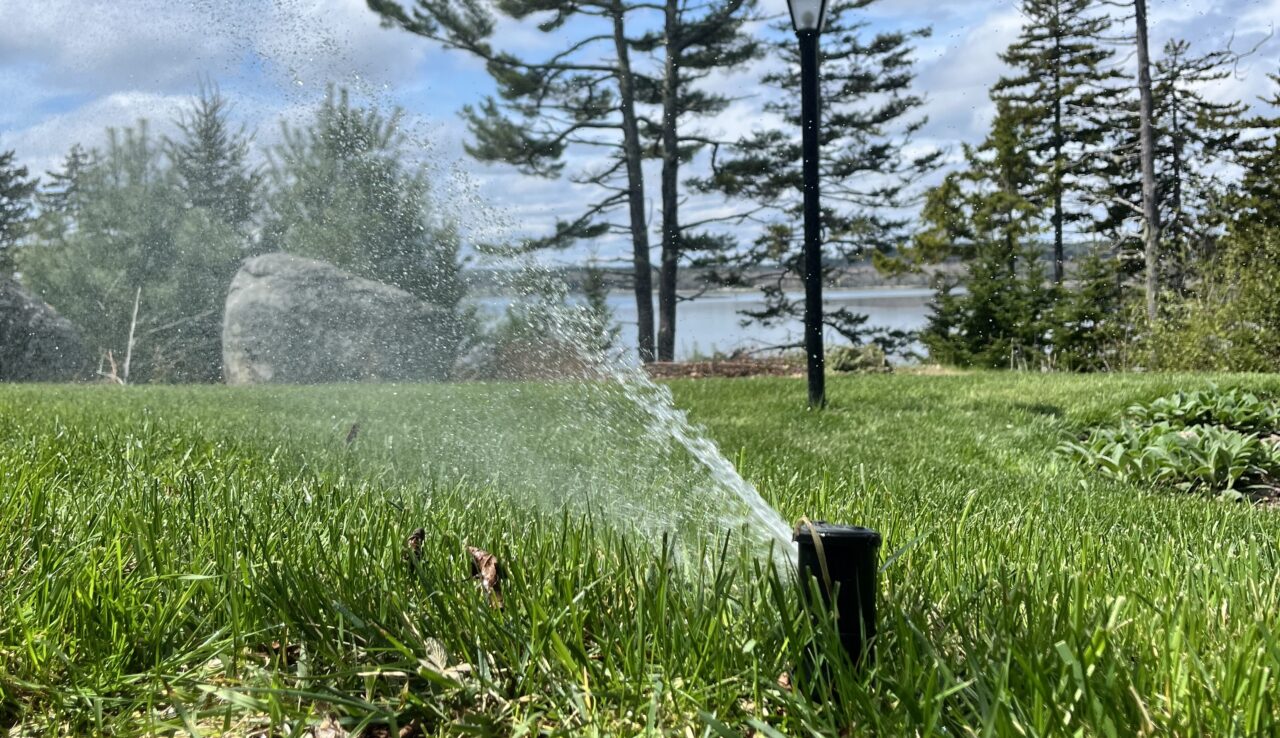
Most homeowners think of irrigation as a convenience, a way to avoid dragging hoses, to keep the lawn green during a dry spell, or to water new seed without having to remember to go outside. All of that is true. But an irrigation system does more than just save time. When it’s running correctly, it fundamentally changes how your lawn grows, how deep its roots reach, how well it competes against weeds and disease, and how effectively it responds to other inputs like fertilizer and overseeding.
At Mainely Irrigation, a Division of Just Grass, Inc., we work alongside the lawn care team at Just Grass on properties throughout the greater Bucksport, Maine area. That combined perspective gives us a clear view of how irrigation and lawn care interact. The lawns that look consistently good through a Maine summer are almost always the ones where water is being managed well.
Water Stress and What It Does to Cool-Season Grasses
Maine lawns are composed primarily of cool-season grasses: Kentucky bluegrass, fine fescues, tall fescue, and perennial ryegrass. These species evolved in climates with reliable moisture during warm months, and they perform best when they have consistent access to water throughout the growing season.
When water supply becomes inconsistent, these grasses respond through a survival mechanism called dormancy. The grass plant redirects its remaining moisture to the crown and roots and lets the leaf blades die back. The lawn turns brown, which understandably alarms most homeowners, but the plant isn’t dead. It’s conserving resources.
True dormancy is a survival response, not a death sentence. But there’s an important distinction between managed dormancy and stress-induced decline. A lawn that goes dormant because of a deliberate decision to stop watering during a drought, and then receives consistent moisture again when conditions improve, can recover with relatively minor long-term damage. A lawn that cycles repeatedly between drought stress and waterlogged conditions over the course of a summer suffers cumulative damage to the crown and root system that’s much harder to recover from.
Consistent irrigation prevents that cycle. Your lawn never gets stressed enough to trigger dormancy, the root system stays active and growing, and the grass enters fall (its most important recovery period) in genuinely good shape rather than depleted.
Root Depth: The Hidden Benefit of Proper Irrigation
The most important effect of good irrigation management isn’t the green color you see above ground. It’s the root architecture developing below it.
Roots grow toward water. In a lawn that’s watered lightly every day, water is consistently available in the top 2 to 3 inches of soil. Roots have no reason to extend deeper, so they don’t. The result is a shallow-rooted lawn that looks fine under normal conditions but becomes vulnerable as soon as stress hits. A few days without rain, a heat wave, heavy foot traffic, or even a temporary coverage gap from a misaligned head can push a shallow-rooted lawn into visible stress very quickly.
In a lawn that’s watered deeply and infrequently, the soil dries slightly between cycles. Roots extend downward in search of moisture, and over time they colonize a much deeper profile. A well-irrigated Kentucky bluegrass lawn with deep roots can draw on soil moisture reserves at 8 to 10 inches or more. That’s a dramatically larger reservoir than a shallow-rooted lawn has access to.
This root depth matters in practical terms. During Maine’s summer dry periods, which can stretch to two weeks or more in July and August, a deep-rooted lawn holds its color and vitality far longer than a shallow-rooted one. It’s also more resistant to the physical stress of foot traffic, which compresses shallow root zones more severely than deep ones.
Turf Density and Weed Competition
A dense, healthy lawn is its own best defense against weeds. Weed seeds are always present in the soil. What determines whether they establish and spread is how much space and light are available at the surface. A thick, actively growing turf canopy shades the soil, suppresses germination, and outcompetes weeds for nutrients and water. Thin, stressed turf leaves gaps in that canopy and effectively invites weeds to fill them.
Consistent irrigation is one of the primary factors that determines turf density. Grass that’s regularly stressed by water shortages doesn’t tiller and spread the way healthy grass does. It holds on with what resources it has rather than actively growing and expanding. That survival posture creates the exact thinning that lets weeds gain a foothold.
Homeowners who struggle with persistent weed pressure often focus on treatment without addressing the underlying conditions that allow weeds to establish. Inconsistent irrigation is frequently part of the picture. Improving water management won’t eliminate weeds on its own, but it removes one of the conditions that makes weeds competitive.
For properties where Just Grass is providing lawn care alongside Mainely Irrigation managing the irrigation system, this is a real advantage. Fertilization, aeration, overseeding, and weed control programs are all more effective when soil moisture is managed consistently.
Fertilizer Effectiveness and Nutrient Uptake
Fertilizer doesn’t work without water. Nutrients move through soil in solution; they’re absorbed by grass roots dissolved in soil water. A fertilizer application on a lawn that’s receiving inconsistent irrigation can sit at the surface, partially available, and partially at risk of being mobilized by the next heavy rain into runoff.
Consistent irrigation keeps soil moisture at the level where nutrient uptake is most efficient. After a fertilizer application, your irrigation system ensures those nutrients are moved into the root zone and held in a form that grass roots can access. Without that consistent moisture, a significant portion of your fertilization investment may not reach the grass at all.
This is particularly relevant in the fall, which is the most important fertilization window for Maine cool-season lawns. Fall applications of balanced fertilizer and potassium help lawns harden off before winter and build the root reserves they’ll draw on during spring green-up. Adequate soil moisture during September and October ensures those nutrients are being taken up effectively rather than sitting inert in dry soil.
Overseeding and New Seed Germination
Overseeding is one of the most important practices in maintaining a dense, healthy Maine lawn. Introducing fresh seed annually or every few years thickens the turf, introduces improved grass varieties, and helps the lawn recover from summer stress and thinning. But germination is entirely dependent on consistent surface moisture.
Grass seed germinates unevenly when moisture is inconsistent. Seeds that dry out during the critical first few days after germination die before they establish. Seeds in areas with better coverage germinate successfully while adjacent areas fail, producing the patchy results that homeowners sometimes attribute to poor seed or bad soil when the real culprit is irrigation inconsistency.
For overseeding to succeed, the seeded area needs to stay consistently moist for the first two to three weeks. That typically means running your irrigation system more frequently than normal, with shorter cycles specifically designed to keep the surface damp without waterlogging. Mainely Irrigation can program a temporary overseeding schedule into your controller and switch back to the standard program once germination is complete.
For properties where Just Grass is performing the overseeding work, coordinating the irrigation schedule with the seeding timing is something we do routinely. The results of a professionally seeded lawn are only as good as the moisture management that follows.
Disease Prevention: The Role Water Plays
Fungal diseases are a consistent challenge for Maine lawns, and irrigation management is one of the primary factors that determines whether a lawn is susceptible. The relationship isn’t simply that too much water causes disease, though overwatering is a risk. It’s about how and when water is applied.
Lawns that are watered in the evening or at night remain wet through the overnight hours. Fungal pathogens need moisture and warmth to establish and spread, and wet grass blades in humid Maine nights provide exactly those conditions. Dollar spot, red thread, and brown patch are all more prevalent in lawns with evening irrigation schedules.
Morning watering, by contrast, leaves grass blades wet for only a few hours before the sun and warmer air dry them out. The lawn gets the water it needs without the extended wet period that promotes fungal development.
Overwatering creates a different disease risk. Saturated soils promote pythium blight, a destructive fungal disease that spreads rapidly in wet, warm conditions. Soils that are consistently waterlogged also become anaerobic, which stresses root systems and makes them more susceptible to root rot pathogens.
A properly calibrated irrigation schedule, running in the early morning hours with run times matched to your soil type and head output, keeps your lawn in the range where disease risk is minimized.
The Value of Consistent Monitoring
An irrigation system that was calibrated perfectly when it was installed will drift over time. Heads shift and get bumped. Nozzles accumulate sediment. Valves develop slow leaks. Trees grow and create new shade patterns that change the water needs of adjacent zones. A system that’s never checked develops subtle inefficiencies that gradually affect lawn quality without any single obvious cause.
Mainely Irrigation’s seasonal service model is built around this reality. Spring startups catch winter damage before it affects the season. Mid-season tune-ups address coverage problems before they create lawn damage. Fall winterizations protect the system so it’s ready to perform again next spring. Over the course of a season, this consistent monitoring keeps the irrigation system working the way it should and keeps your lawn receiving the water it needs.
Irrigation and Your Lawn: A Partnership
The connection between irrigation management and lawn health isn’t incidental. Consistent, properly managed irrigation is foundational to everything else your lawn needs to thrive, from root depth and turf density to fertilizer uptake and overseeding success.
Mainely Irrigation serves residential and commercial properties throughout the greater Bucksport, Maine area. As a Division of Just Grass, Inc., we work alongside the Just Grass lawn care team to make sure the properties we both serve are getting the best possible results from both programs.
Call us at 207-702-9074 or contact us online to schedule a service visit, a spring startup, or a full system consultation. Getting your irrigation right is the starting point for a lawn that looks good through every part of the Maine growing season. A Division of Just Grass, Inc.